网球计分,完整版
网球计分规则
最后更新:2026年9月25日
Tennis scoring builds points into games, games into sets, and sets into a match. Here is the full path from love to match point, including deuce, service order and tiebreaks.
简短版。 A game runs love, 15, 30, 40, game. At deuce, play either continues with advantage or uses one deciding no-ad point. A set is normally first to six games by two, with a tiebreak at 6–6. A match can be one set or best of three, with an optional match tiebreak to ten in place of a deciding set.
记分而不为记分吵架 · ITF · Rules of Tennis
一局中的分数
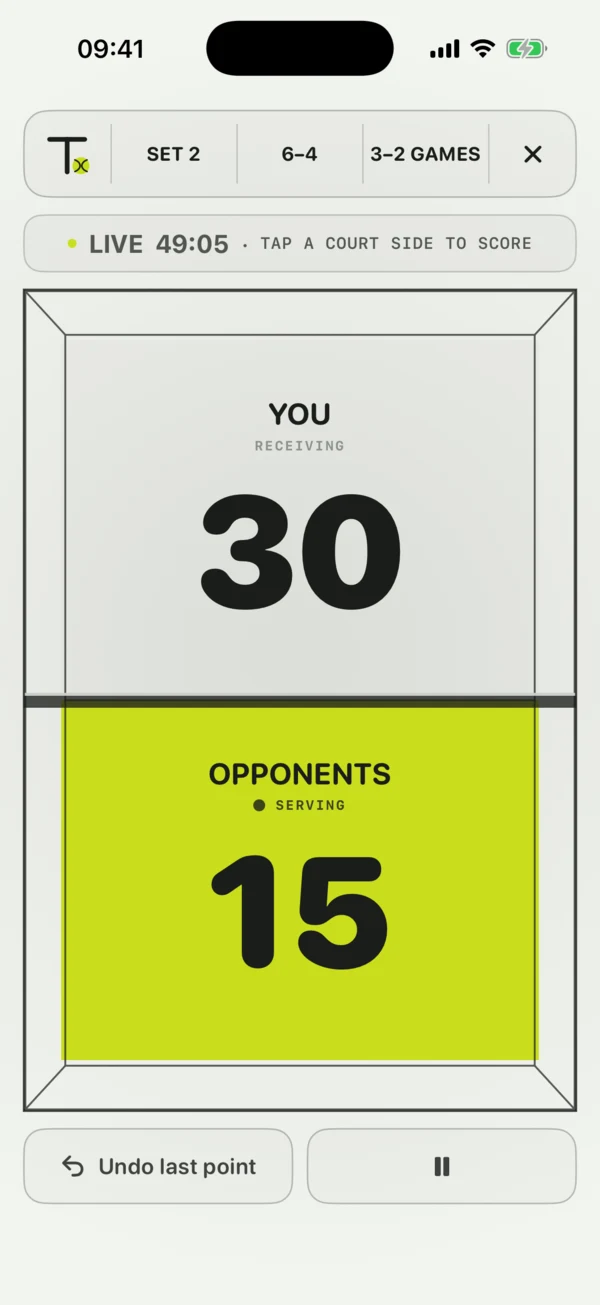
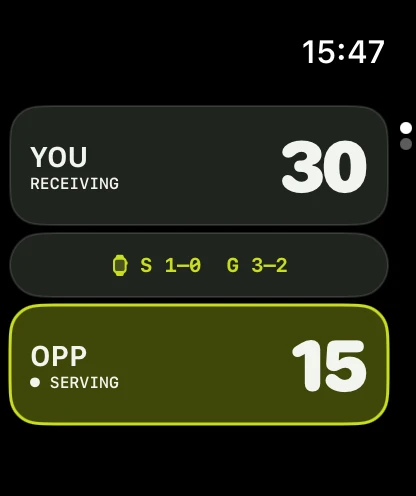
The first point a side wins takes it to 15, the second to 30, the third to 40, and the fourth can win the game. Zero is called love, and the server's score is said first, so 30–15 means the server or serving team is ahead.
| 赢得的分数 | 叫作 |
|---|---|
| 0 | 零分 |
| 1 | 15 |
| 2 | 30 |
| 3 | 40 |
| 4 | 局 — 如果结尾方式允许 |
At 40–40 the score is deuce. What happens next depends on whether the match uses traditional advantage or no-ad scoring.
打到 40–40 会怎样
Choose the deuce rule before the first serve so it stays consistent throughout the match.
占先
From deuce, a side must win two consecutive points. The first creates advantage; winning the next takes the game. If the opponent wins at advantage, the score returns to deuce.
No-ad
From deuce, the next point wins the game outright. This shortens matches and is commonly used in timed, recreational and some competition formats.
Tennismatic asks for advantage or no-ad before the match and applies that selection every time a game reaches deuce.
一盘中的局数
A standard set goes to six games, won by a margin of two. At 5–5 it continues to 7–5; at 6–6 it is decided by a tiebreak.
The set tiebreak is first to seven points with a two-point margin. A 7–5 score finishes it; at 6–6 play continues until one side leads by two. The set is recorded 7–6.
一场比赛中的盘数
A Tennismatic match is one set or best of three. Best of three means the first side to win two sets, so the match ends 2–0 or 2–1.
At one set all, play a full deciding set or replace it with a match tiebreak: first to ten points, still by a two-point margin.
谁发球,什么时候发
The server's score is called first, so Tennismatic always shows which side is serving.
- In singles, service alternates between players after each game. In doubles, teams alternate and keep a fixed player order within each team.
- The same player serves every point of a game, alternating the service court from right to left.
- Players change ends after the first game and after every two games thereafter—whenever the total games played is odd.
- In a tiebreak, the first server serves one point. Service then changes every two points, and players change ends every six points.
What Tennismatic tracks
Tennismatic tracks the score and serving side. Players still decide calls, receiving positions and changeovers on court.
| 规则 | 网球 |
|---|---|
| 一局中的分数 | 15, 30, 40, game |
| 40–40 时 | Advantage or no-ad, selected before play |
| 一盘中的局数 | First to 6, by two |
| 决胜盘 | Full set or match tiebreak to 10 |
| Standalone tie-break | First to 7 or 10, win by two |
Standalone tie-breaks and custom points
A standalone tie-break skips games and sets. Choose first to seven or ten, win by two. The first server plays one point and service then alternates every two points—the same one-two-two pattern used in set tiebreaks.
Tennismatic also has a custom total-points mode where you choose the target, service-turn length and whether a two-point margin is required.
记分而不为记分吵架
Every rule above is arithmetic, and arithmetic is easy to lose in the middle of a long rally. A changeover, a deuce rule nobody confirmed, one player certain it was 30–15—and the score becomes a negotiation instead of a fact.