Tennis scoring, in full
Tennis scoring rules, explained
Last updated 25 September 2026
Tennis scoring builds points into games, games into sets, and sets into a match. Here is the full path from love to match point, including deuce, service order and tiebreaks.
The short version. Points → games → sets → match. In a game, count 0 (love), 15, 30, 40. Win at least four points with a two-point lead in advantage scoring. A usual tiebreak set needs six games with a two-game lead, or a tiebreak at 6–6. Best of three means winning two sets. Tournament formats can differ; agree the format before playing.
How to keep tennis score on Apple Watch and iPhone · ITF · Rules of Tennis
Points in a game
The first point a side wins takes it to 15, the second to 30, the third to 40, and the fourth can win the game. Zero is called love, and the server's score is said first, so 30–15 means the server or serving team is ahead.
| Points won | Called |
|---|---|
| 0 | Love |
| 1 | 15 |
| 2 | 30 |
| 3 | 40 |
| 4 | Game — if the ending allows it |
At 40–40 the score is deuce. What happens next depends on whether the match uses traditional advantage or no-ad scoring.
What happens at 40–40
Choose the deuce rule before the first serve so it stays consistent throughout the match.
Advantage
At 40–40 (deuce), win two consecutive points to take the game. Example: Alex wins a point → advantage Alex. Sam wins the next → deuce again. Alex wins the next two → advantage Alex, then game Alex. One point after deuce is not enough.
No-ad
From deuce, the next point wins the game outright. This shortens matches and is commonly used in timed, recreational and some competition formats.
Tennismatic asks for advantage or no-ad before the match and applies that selection every time a game reaches deuce.
Games in a set
In a tiebreak set, six games with a two-game lead wins: 6–0 through 6–4. At 5–5, a player can win 7–5. At 6–6, play a tiebreak. An advantage set instead continues until a two-game lead; check your competition’s format.
Worked tiebreak: Alex leads 6–5 in points. If Alex wins the next point, 7–5 ends the tiebreak. If Sam wins, it becomes 6–6; Alex then needs two straight points to win 8–6. The set score is 7–6, not 8–6. The ordinary set tiebreak target is seven; some competition formats use ten.
Sets in a match
A Tennismatic match is one set or best of three. Best of three means the first side to win two sets, so the match ends 2–0 or 2–1.
At one set all, play a full deciding set or replace it with a match tiebreak: first to ten points, still by a two-point margin.
Who serves, and when
The server's score is called first, so Tennismatic always shows which side is serving.
- In singles, service alternates between players after each game. In doubles, teams alternate and keep a fixed player order within each team.
- The same player serves every point of a game, alternating the service court from right to left.
- Players change ends after the first game and after every two games thereafter—whenever the total games played is odd.
- In a tiebreak, the first server serves one point. Service then changes every two points, and players change ends every six points.
What Tennismatic tracks
Tennismatic tracks the score and serving side. Players still decide calls, receiving positions and changeovers on court.
| Rule | Tennis |
|---|---|
| Points in a game | 15, 30, 40, game |
| At 40–40 | Advantage or no-ad, selected before play |
| Games in a set | First to 6, by two |
| Deciding set | Full set or match tiebreak to 10 |
| Standalone tie-break | First to 7 or 10, win by two |
Standalone tie-breaks and custom points
A standalone tie-break skips games and sets. Choose first to seven or ten, win by two. The first server plays one point and service then alternates every two points—the same one-two-two pattern used in set tiebreaks.
Tennismatic also has a custom total-points mode where you choose the target, service-turn length and whether a two-point margin is required.
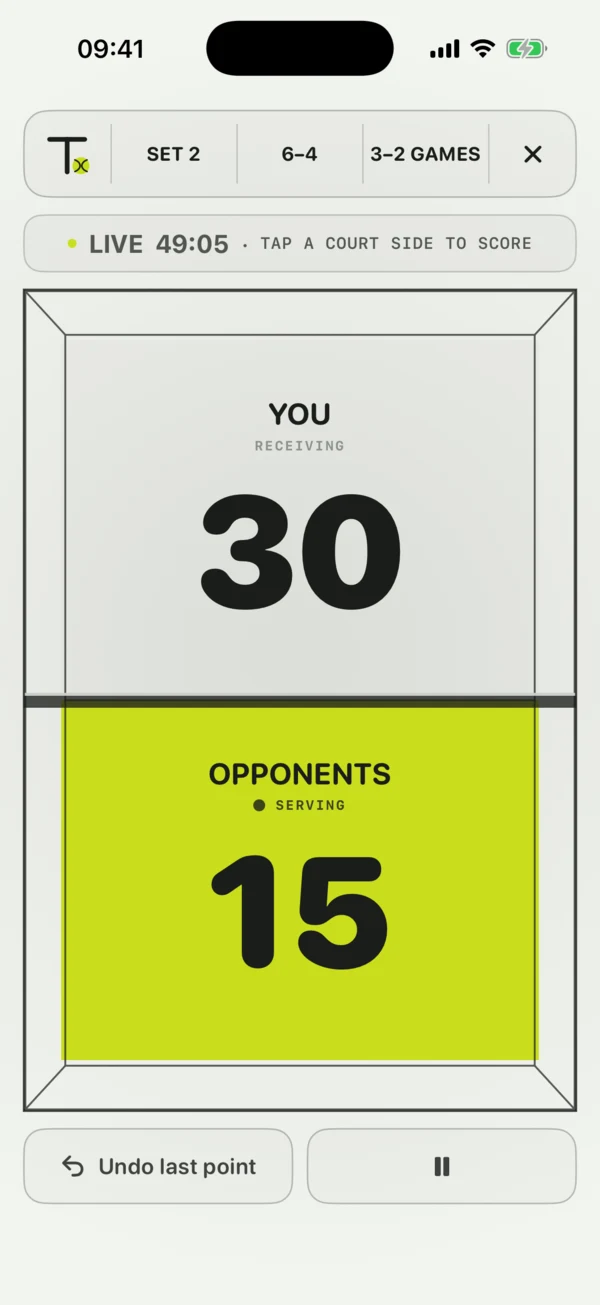
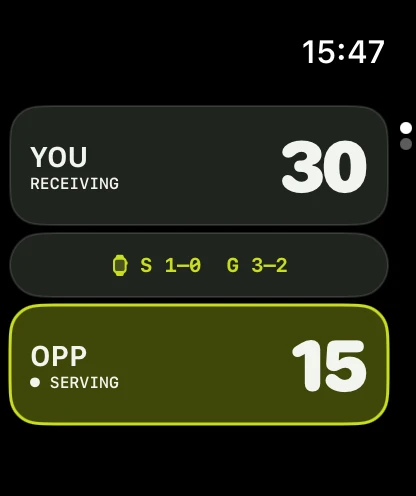
How to keep tennis score on Apple Watch and iPhone
Choose the match format, advantage or no-ad, match length and first server before tapping Start Match. On the scoring device, tap the side that wins each point. At deuce, keep recording individual points: Tennismatic applies your chosen rule. At 6–6 in games, the configured tiebreak starts automatically. On Apple Watch, open Match Controls for Undo if you record a point incorrectly. If the Watch is a read-only mirror, score on the device that currently controls the match. Match scoring requires Tennismatic Pro; download and purchase details are shown on the App Store.